
Tabs organizes content into a set of panels that share the same space. A tab strip sits across the top of the block. Learners select a tab to show its panel, and only one panel shows at a time. CreateUpon labels the tabs Tab 1, Tab 2, and so on until you rename them.
Tabs works well for:
• grouping related content without making the card long
• comparisons, such as plans, options, or before and after
• optional or supplementary detail a learner can open when needed
• content you want to keep compact on the page
If the tab strip is wider than the card, it scrolls sideways so every tab stays reachable.
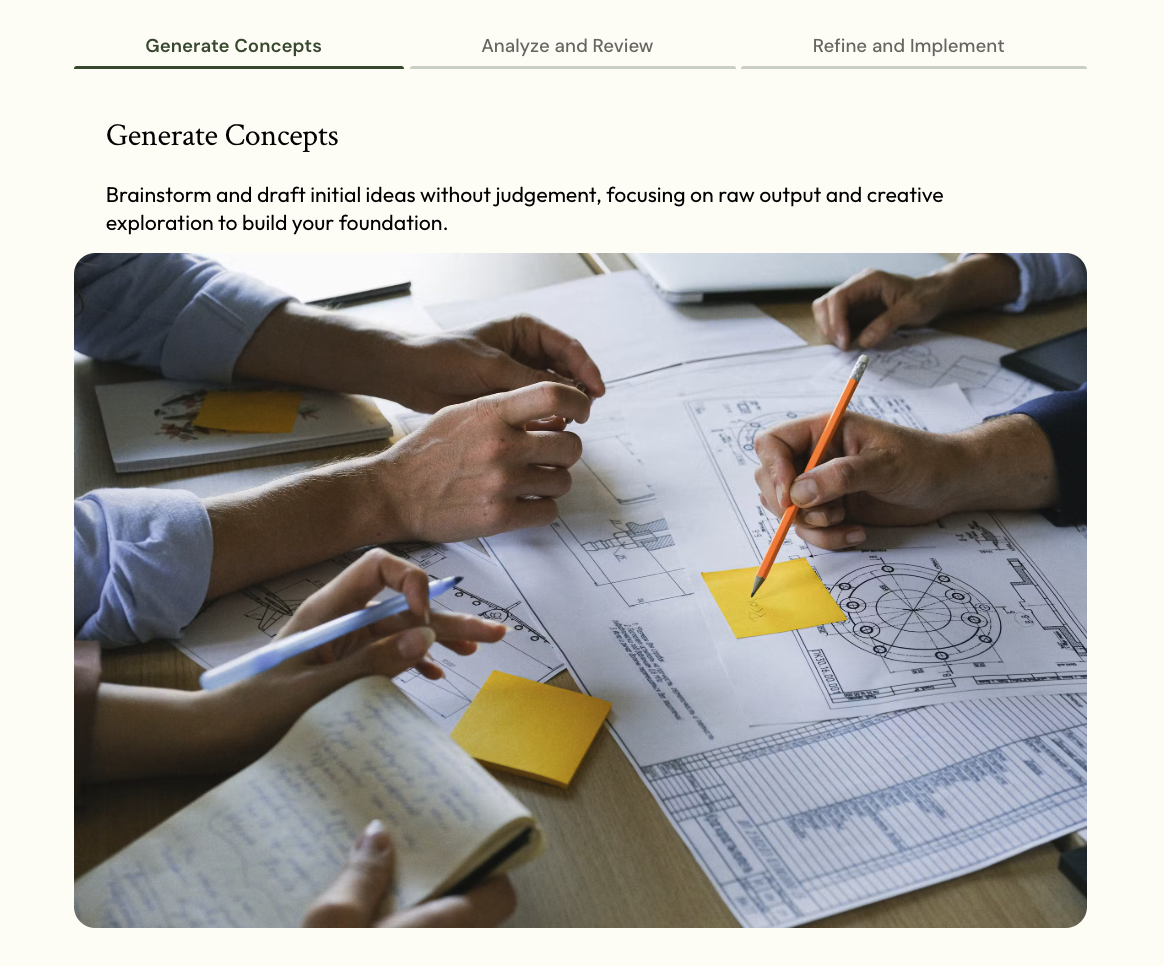
You can add a Tabs block anywhere in a lesson card.
1. Open the lesson in the lesson editor.
2. Place the cursor on an empty line inside a card.
3. Type / to open the insert menu, then select Tabs.
The editor adds a Tabs block with 2 tabs. Each tab starts with a placeholder heading and description.
Each tab has a label. New tabs are labeled Tab 1, Tab 2, and so on.
1. Select the tab label in the tab strip.
2. Type a new label.
3. Press Enter to save, or Esc to cancel.
Tabs you have not renamed keep their default numbering and update as you add or remove tabs.
Each tab holds its own panel. A panel accepts any kind of block content. You can add:
• headings and paragraphs
• images, videos, and other media
• code blocks
• nested layout blocks
Select the tab you want to edit, then select inside the panel and type or paste your content.
A Tabs block supports 2 to 8 tabs.
1. Select the Tabs block.
2. In the toolbar, find the cell counter.
3. Select + to add a tab, or − to remove the last tab.

The toolbar above a selected Tabs block offers more controls.
• Layout type: switch between Grid, Steps, Timeline, Alternating, Cycle, Tabs, and Accordion
• Color: set a color for the block
• Constrain width: limit the block to 800 pixels wide, or switch to Full width to fill the page
• Icon: add an icon next to a tab's label. Select the tab, then pick an icon from the cell toolbar.
